Winded.
Rejection, performance and the creative brain. And how to know when it is more than that.
A talk in four acts by Dr Asad Raffi, in conversation with Rosie Turner and Michaela Thomas, followed by the evidence in depth.
One idea, four acts.
This is the written version of tonight's talk, for you to take home. For most people in this room, rejection is a performance question: how to keep making brave work in a career built on being judged. For some, it is more than that. This talk is about both, and about how to tell which one is yours.
You are not the only creatives in the room.
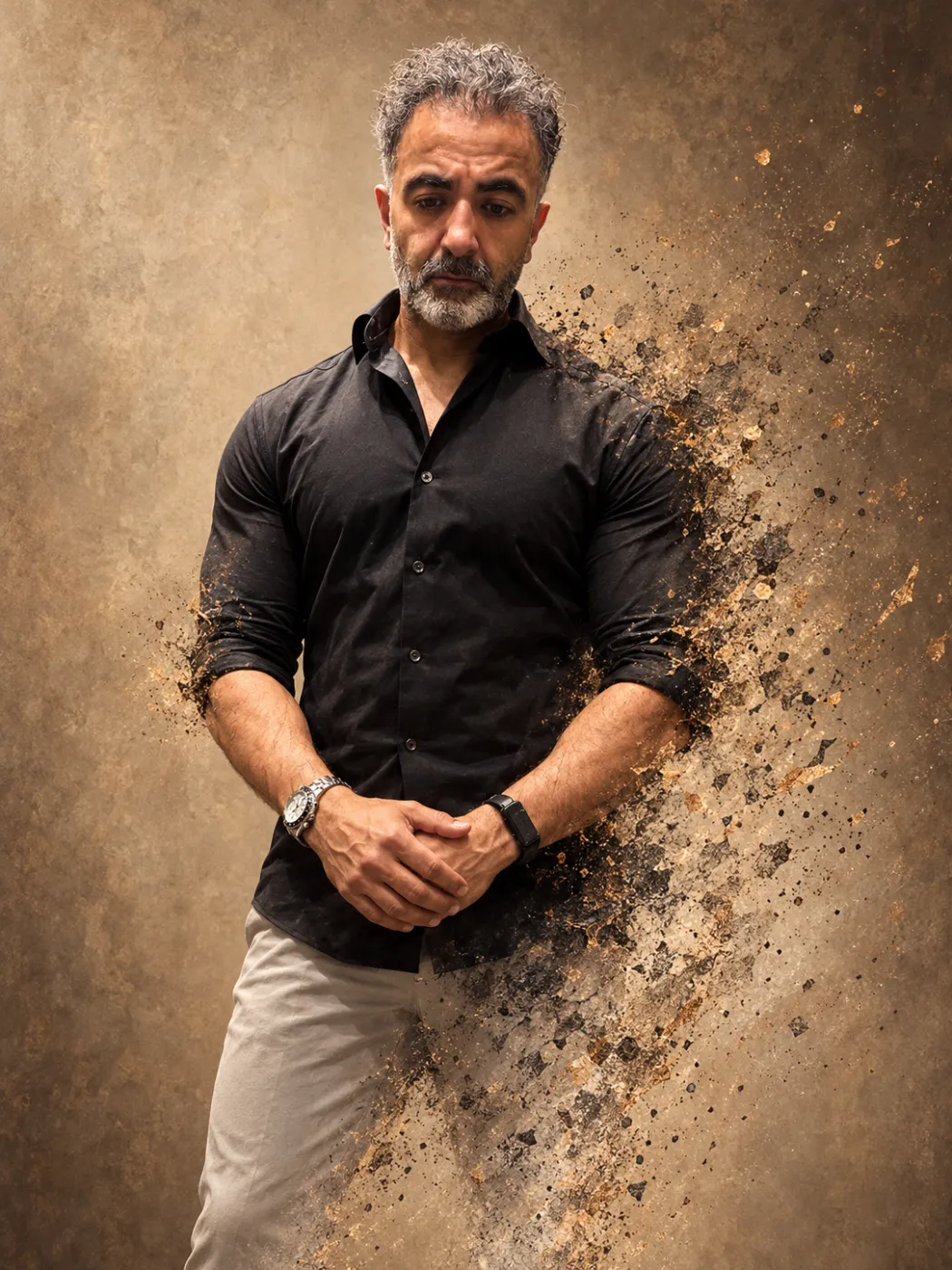
I am Dr Asad Raffi, founder of Sanctum Healthcare. I spend my working life with brains that think differently, and I have one of my own.
Divergent thinking is not only the domain of artists. It is the domain of doctors too. A good diagnosis starts by holding many explanations open at once, then narrowing them down against the evidence. It is pattern, rhythm and a feel for the note that does not fit. Medicine is creative work, done carefully.
Outside the clinic: coffee, music, cars and cats.
You sent the work. The reply didn't come.
Let me start with a moment I think most of you know.
You send something you made. A pitch, a cut, a draft, a deck, a demo. You read it once more after you hit send and notice the thing you would change. Then you wait.
An hour passes. The message has been read. No reply. And somewhere under your ribs something drops, like a lift that has lost its cable. Your face goes hot. You know, quite clearly, that they hated it. That they have finally seen through you.
You know, too, that this is out of proportion. They are probably in a meeting. Knowing it changes nothing. You check your phone at midnight, and again at four.
The next morning they reply: "Love it. One small note." And the whole thing drains away in about a minute, leaving you exhausted and a little ashamed of the night you just had.
Asked for one word for that feeling, most people choose winded.
Now look around you.
This club was built for the creative industries: film, fashion, music, advertising, media, architecture and the widening circle around them. Around 270,000 people belong to a House like this one. Most are somewhere between their mid-twenties and mid-forties, and most stay year after year.
What almost everyone here has in common is not a postcode or an income. It is that you chose a working life built on being judged. Castings, crits, reviews, pitches, edits, award lists, follower counts, the client who goes quiet. Few careers schedule so much evaluation into an ordinary week. And for many of you, the work is not just what you do. It is who you are. So when the work is judged, you are.
You chose a career built on being judged. Some brains pay more for that than others.
Your sensitivity is part of the instrument. Learn to play it.
Let me be clear about something first. Minding rejection is not a disorder. It is human.
Everyone in this room wants their work to land, and everyone feels it when it doesn't. For most of you, tonight is not about illness at all. It is about performance: how to keep making brave work, sending it out and going back for more, in a career that will judge you every week for the rest of your life.
Athletes have learned this. Nobody tells a sprinter that nerves are a weakness. They learn what drives their nerves up and down, and they build their training, sleep and recovery around it. Creative people almost never get that conversation. I want to give it to you.
Creative fields draw a particular kind of brain. People with ADHD traits tend to be better at generating ideas, and the advantage peaks at moderate levels, below anything you would diagnose. Creative fields also draw more autistic people, more people on the milder end of the mood spectrum and a lot of people high in openness and emotional sensitivity.
That same wiring tends to fire fast and settle slowly. The brain that makes unexpected connections is the brain that reads a pause in a meeting as a verdict. The sensitivity that lets you notice the one person being left out of the room is the sensitivity that lets a slight land like a blow. It is one instrument. You do not get to keep half of it.
The same system that makes a slight land like a blow makes a kindness land like a gift.
At Sanctum we think about every brain through one equation. How you perform on any given day is the result of four things: your wiring, the amplifiers that turn it up or down, the demands on you and the supports that share the load.
The wiring is the constant. Everything else moves. That is why the same note from the same producer can sting on Tuesday and flatten you three weeks later.
The late nights, the stress, the week before a period, perimenopause, the third coffee, the drinks at the launch. The "creative fuels" mostly do not make better ideas. They turn the volume up.
The pitch, the review and the launch landing in the same week. Social media that scores you in public. Irregular income.
A collaborator who knows how you take notes. Feedback in writing. Protected time off. Someone to do the invoices. Most freelancers have to build these themselves.
Three of the four terms are yours to move. Sleep and a walk before the ideas session have better evidence than anything in a bottle.
You are not too sensitive. You are running a high-gain instrument without a sound engineer.
For some of you, this is more than performance. Here is how to tell.
Here is the part that matters most. Performance and illness are not two kinds of people. They are two ends of one line, and the same equation runs along all of it. At one end, you are doing well and want to do better. At the other, it has become a clinical problem that needs assessment and treatment. Most of this room sits towards the performance end. A proportion of you do not, and some of you will not know it yet, because you have been very good at hiding it.
There is a name for the far end of this pattern: rejection sensitive dysphoria, or RSD. It is not a diagnosis. It is a description that people recognise the instant they hear it: a fast, intense, short-lived response to criticism or rejection, felt in the body first, out of proportion and known to be. It is most often part of ADHD, and it is where ADHD meets other people. By the time someone reaches us in their thirties or forties, the thing bringing them in is almost never their attention. It is the friendship that ended before it could end on them, the job they left after one appraisal, the invoice never sent.
The note hurts. You sulk for an evening, call a friend, make the change and send it back. It might even sharpen the next draft: some people do their most original work straight after being turned down.
It sounds like: "That stung. Fine. Let's go again."
The reaction is starting to make your decisions. You don't send the work in case it is judged. You rework it at 2am so nobody can find fault. You say yes to everything. You go quiet on the friend before they can go quiet on you. It still passes, but it is costing more each time, and your sleep, your drinking or your scrolling are taking up the slack.
It sounds like: "I'll send it when it's ready." (It is never ready.)
It is organising whole areas of your life. Friendships quietly lost over years. Jobs left after one appraisal. The mask that doesn't come off even at home. An episode can take a day or a week out of you, and in the worst of it you may have thought about not wanting to be here. This is the point to be assessed properly, because there is usually something underneath, most often ADHD, that can be treated.
It sounds like: "I don't know how I ended up with two friends."
None of these is a test. Together they tell you which way you are leaning.
Feeling the sting is human. When it starts making your decisions, it is time to look underneath.
You don't make yourself less sensitive. You change the equation around you.
The tools are the same along the whole line. What changes is how many you need and whether you need a clinician alongside you.
| Where | What helps |
|---|---|
| The sting Name it · amplifiers | Protect sleep before idea days. Walk before you brainstorm. Coffee for editing, not for ideas, and none after about 2pm. Read notes at a time you choose, not on your phone at midnight. Don't stack the pitch, the review and the launch in one week. |
| The swerve + work on the loop | All of the above, plus: agree how feedback reaches you (in writing, in private, with notice). Make a 24-hour rule for any big decision made in an episode. Take one small step towards what you are avoiding, one message, one submission, and notice what actually happens. Coaching and tracking help here. |
| The collapse Safety · treat the ADHD · template | A proper assessment. Treating ADHD reduces how often and how hard the reaction hits for many people. Hormonal care where the cycle or perimenopause is part of it. Psychological work between episodes on the loop that keeps them going. A short safety plan, kept to hand. |
If you manage, commission, cast or collaborate with creative people, you are part of their equation. You are a demand or a support, often in the same email. Give notes in writing where you can. Say what works before what doesn't. Reply, even briefly, when someone has sent you their work. And when you get it wrong, repair quickly. For a rejection-sensitive brain, a fast repair ends the whole thing in minutes.
In couples, the pattern is often a dance. One of you pursues: the extra message, the "are we OK?". The other withdraws: goes quiet, says it is fine. Each move confirms the other's fear. Pursuit reads as danger; withdrawal reads as abandonment. The cycle belongs to the pair, never to one person. And behind the partner's completely flat face, the heart is often racing. It is not indifference. It is the opposite.
Two rules help. Validate before you reassure. And never pause without a time to come back: "I've been triggered, let's talk at eight."
None of these has been tested as a treatment for RSD. Each fits the model and is safe to try.
The aim is not to stop feeling rejection. It is to stop it deciding what you make, send and apply for.
It is a volume problem, not a character problem. And volume can be turned down.
Rosie's questions, answered.
Is RSD the main driver of ADHD?
It is not the cause. It is the engine of the impairment. The attention and the restlessness are the wiring. What takes people down is what happens around it: years of being told they are late, careless or too much, and a nervous system that fires in under a second and settles slowly. It is where ADHD meets other people, and that is where the damage lives.
One comment the week before my period and I'm done. Hormones, RSD or both?
Both, and they are not separate. Oestrogen helps keep the brain's natural buffer against social pain stocked. In the last week of the cycle it falls, and the comment lands on a brain with less regulation and less painkiller than a fortnight earlier. Perimenopause is that week made erratic for years. You are not overreacting.
Can medication help?
Yes, for many people. ADHD medication strengthens the brain's brake on its alarm, though its effect on emotion is about half its effect on attention. Some clinicians use guanfacine or clonidine for this, but there is no trial for RSD. What medication cannot do is erase years of learning that feedback is dangerous, or the avoidance that stops that belief ever being tested. That part is the work.
Is it a personality disorder?
The reaction can look the same from outside. The difference is what is there between episodes. With rejection sensitivity you are yourself again when nobody is judging. A personality disorder carries emptiness and an unstable sense of self even in calm periods. Too often that label is collected first, and it closes the ADHD question for years.
Can only people with ADHD have it?
No. Everyone has some rejection sensitivity. It is loud in social anxiety, after trauma and in autistic people who have been rejected all their lives. What ADHD adds is the speed and the size of the reaction, and a history that makes the expectation reasonable.
Environment or genetics?
The nervous system is inherited. The sensitivity to criticism is learned, accurately, from a world that corrected what the person could not control. The second part is the one we can change.
Where is the strength in it?
These are the people who notice who is being left out, who read a tone before anyone else, who care about getting it right. Turn the judgement off, and what is left is someone who reads a room better than most and wants connection badly enough to work for it. That is not a bad thing to bring to a creative life.
The evidence in depth.
The Brain Health Model applied to creative people: the wiring, the amplifiers, the demands of the work, the supports that are missing, where rejection sensitivity fits, and what helps. Each part ends with notes for clinicians.
ADHD and divergent thinking
Divergent thinking is the ability to generate many ideas. Convergent thinking is finding the single right answer. The research is fairly consistent that ADHD traits go with stronger divergent thinking and make no difference to convergent thinking. The effect is small to moderate, and a little larger in adults.
Two details matter. The advantage peaks at moderate, below-diagnosis trait levels and does not keep rising with severity. And it depends on context: in one experiment adults with ADHD were more creative only when competing for a reward. The wiring that generates ideas is the same wiring that struggles with boredom, finishing and regulation.
Diagnosed ADHD in creative jobs
Here the evidence points the other way. A study of the whole Swedish population found people diagnosed with ADHD were less often in creative professions than controls. Those registry cases were young, hospital-diagnosed and relatively severe, so the study says little about successful adults with ADHD traits. Industry surveys are more encouraging but self-selected: in one survey of electronic-music workers, 58% described a neurodivergent condition, though only 38% had a diagnosis.
The defensible position: creative fields are likely to draw people with high ADHD traits. No robust study shows diagnosed ADHD is over-represented in creative professions.
The other neurotypes in the room
Bipolar spectrum. This is the strongest population signal in creativity research. People with bipolar disorder, and the healthy siblings of people with bipolar disorder or schizophrenia, are over-represented in creative professions. The link is strongest for milder forms and family history. Unipolar depression shows no such pattern.
Autism. The proportion of autistic students on creative art and design courses is almost three times that of students with no disability. Dyslexia is also common among art students.
Temperament. Openness to experience is the trait most consistently linked to creativity. Anxiety and emotional sensitivity are relatively common among artists.
In any creative audience, then, ADHD, autism, both together and the bipolar spectrum will all be present. That matters most when someone describes big emotional swings, because the cause could be any of them.
Creative fields draw the traits, not necessarily the diagnosis. Being creative does not mean having ADHD.
Hoogman et al. (2020): enhanced divergent thinking in ADHD, no effect on convergent thinking. Earlier meta-analysis of 10 studies: g = 0.36 overall, g = 0.57 in adults. A population study (n = 470, plus 151 case-control) found the association plateaus in the clinical range. Kyaga et al. (2012): ADHD 1.2% against 2.4% of controls in creative professions (p < 0.0001); creative professions more common in relatives of people with schizophrenia, bipolar disorder, anorexia nervosa and, to some extent, autism. Polygenic risk for schizophrenia and bipolar disorder predicted creative profession or artistic society membership in people without psychosis.
A repeating pattern runs through this part. The things creative culture treats as fuel (late nights, pressure, caffeine, alcohol, nicotine, drugs) mostly do not improve idea generation, and several make it worse. What they reliably do is turn up the amplifiers that make a neurodivergent brain harder to run.
Sleep
Creative people report later body clocks, more insomnia and sleep that feels less restorative. In the largest comparison, performing musicians had more insomnia symptoms than the general population, alongside higher job demands and less support. ADHD adds its own delay: insomnia affects between 43% and 80% of adults with ADHD, and a delayed body clock about a quarter, against at most 3% of the general population. Touring, late performances and freelance deadlines push it further.
Stress
The evidence here is stronger than for sleep. In England, suicide risk in culture, media and sport occupations was 20% above average for men and 69% above for women, and highest in artistic, literary and media jobs. Among women, artists had about four times the average risk. The highest-paid group had the lowest risk: the danger tracks low pay, insecurity and lack of control. An established, well-paid creative is not in the same position as a freelancer starting out.
The stress that creative work involves, being judged and not being in control, reduces creative performance in experiments. Pressure is not the muse.
Hormones
Ideas tend to be most original around ovulation and least original in the late luteal phase, the week or so before a period. The more useful finding is about transitions. In a Dutch adult ADHD clinic, 45.5% of women had premenstrual dysphoric symptoms and 57.6% had postnatal depressive symptoms after a first birth, with perimenopause far more severe than in comparison women. In the music industry, nearly half of those who had experienced perimenopause or menopause said it affected their work, and most had told no one at work.
Nutrition and eating
Sugar does not lift mood; within an hour it brings more fatigue and less alertness. About one adult in seven meets criteria for addiction-like eating of ultra-processed food. ADHD roughly quadruples the risk of eating disorders, mostly binge-type; autism is linked to restrictive eating; and appearance-driven work such as dance and modelling carries a high risk of restriction. Any creative audience will contain people who binge, people who restrict and people moving between the two, so we lead with eating patterns, not weight loss.
Movement
Movement has the clearest evidence of any lifestyle factor. Walking increased idea generation for 81% of people in one set of experiments, and the boost carried over to sitting down afterwards. Two meta-analyses confirm the effect. Exercise also treats low mood and helps ADHD. The caveat is dose: hard training can briefly make creative thinking worse, so save it for after the ideas session.
Physical health
Dancers and musicians have very high rates of joint hypermobility: 72% of elite dancers in one study. ADHD and autism are strongly linked to hypermobility, and through it to an over-reactive nervous system, pain and anxiety. The bendy body and the divergent brain often arrive together. Famous popular musicians also die earlier, mostly from lifestyle-related causes.
Substances
| Substance | Effect on creativity | What it costs |
|---|---|---|
| Caffeine | One strong coffee improved problem solving but not idea generation. It finishes ideas; it does not create them. | Afternoon caffeine cuts sleep without people noticing. Last cup by about 2pm. |
| Alcohol | No reliable benefit. A narrow puzzle effect did not replicate in a larger study. | Used to get through networking, especially by people with ADHD or social anxiety. Worsens sleep and mood. |
| Nicotine | Never tested on creativity. Modestly sharpens attention and speed. | Much of the lift is relief from withdrawal. Costs deep sleep. Heavy use is a reason to assess for ADHD. |
| Other drugs | People believe drugs make them more creative than they do. Where any help, it is for people with low baseline creativity. | The already highly creative have the most to lose. High-potency cannabis and psychosis risk; cocaine dependence. |
Table 1. Substances and creative work.
Mood and mental health
Energised, positive moods help creative work. Low mood and anxiety do not; they are not creative fuel. Yet music and arts students report more anxiety and depression than other students, and creative surveys in every sector report high anxiety, depression and burnout. The tortured artist is a cost, not a method.
Pressure, coffee and a drink do not make the ideas. Sleep and a walk do.
Sleep. Norwegian musicians (n = 1,607): insomnia 6.9 percentage points above the general population (95% CI 3.9–10.0), Bergen Insomnia Scale. Delayed sleep phase in about 26% of adults with ADHD.
Stress. ONS 2011–15: female artists SMR 399 (95% CI 244–616). Managers, directors and senior officials had the lowest risk.
Hormones. Dorani et al. (2021), 209 women at an adult ADHD clinic; single clinical sample, recalled postnatal symptoms. UK Music 2022 (n = 2,980): 47.5% of those with menopause experience reported work impact.
Eating and substances. Carbohydrate and mood: 31 studies, no benefit. Addiction-like UPF eating 14% across 281 studies. Caffeine 200 mg against placebo (n = 88). Crime Survey England and Wales 2025: any drug in the past year 8.7% of 16–59-year-olds; no creative-specific figures. Nicotine and caffeine withdrawal, and cocaine or alcohol comedowns, can all look like rejection sensitivity.
Movement. Walking and idea generation: d = 0.82 in randomised studies.
The demands of creative work
Judgement by design. Reviews, auditions, pitches, crits, castings, client feedback, award lists. Few careers schedule so much evaluation.
Social media as part of the job. Feedback that is public, counted and delayed. It is now the most-cited driver of burnout in music-industry surveys.
Irregular income. Money stress makes thinking worse, and freelance precarity is the norm in many creative fields.
Long hours and crunch. Screen, games and production work normalise very long hours. Deadlines are fixed; the work expands to meet them.
Nights, touring and networking. Late performances, travel and the social work of staying visible, often around alcohol.
Appearance as currency. For performers and anyone in image-led work, the body is part of the product.
Soho House has about 270,000 members worldwide, around 106,000 of them in the UK. Membership is for the creative industries and an increasingly wide set of adjacent professions. The core age band is estimated at 25 to 40, members are comfortably off rather than wealthy, and retention is unusually high: 94% a year on average between 2016 and 2020.
What that means here: a group whose work and identity are tied to being judged, selected for career success and young enough that hormonal transitions, parenting and peak workload often overlap. Success and resources may hide difficulty rather than remove it.
The supports that are missing
Most employees have a manager, an appraisal format, HR, occupational health and a predictable week. Freelance and project-based creatives often have none of these. The structures that would divide the load (agreed feedback formats, adjustments at work, protected time off, someone to do the admin) usually have to be built by the person themselves, and building structure is exactly what ADHD makes hard.
The supports with the best fit for creative lives are practical: protected time away from the work, sleep anchors, walking breaks before idea sessions, admin scaffolding such as a bookkeeper or body doubling, friction against impulsive spending, agreed ways of receiving feedback and treating the ADHD, anxiety or sleep problem underneath.
| Term | In a creative life | The lever |
|---|---|---|
| Neurotype | High ADHD traits, autism, AuDHD, bipolar spectrum, high openness. | Assess properly; treat what is there. |
| Amplifiers | Late body clocks, chronic stress, hormonal transitions, irregular eating, hypermobility, the "creative fuels". | Sleep first; caffeine timing; movement; hormonal care; honest substance review. |
| Demands | Constant evaluation, social media, precarity, crunch, nights, appearance. | Pace high-judgement events; set boundaries on feedback and platforms. |
| Supports | Often self-built or absent, especially for freelancers. | Detachment time, admin scaffolding, coaching, feedback agreements. |
| Functioning | Success on stage; strain in relationships, money and health. | Track the whole life, not just the output. |
Table 2. The Brain Health Equation in a creative life.
Creative careers load the top of the line. Most of the leverage is underneath it.
Membership: 269,606 at 28 September 2025 (company results); UK 72,921 Soho House members plus 33,072 on other memberships. Retention 94% average 2016–2020 (IPO filing). The average age of about 37, the 25 to 40 core and the household income range are third-party estimates and low confidence. Gender, ethnicity and geography are not published. Demands has no measure in the current Sanctum batteries; for creatives, record freelance status, income stability and scheduled evaluation load.

Why the fit is so close
Rejection sensitive dysphoria, or RSD, is a fast, intense, short-lived response to criticism, rejection or failure, felt in the body first. Its trigger is evaluative: it needs a judge. Creative work supplies one daily. Put a neurotype that fires fast and settles slowly into a career built on reviews, auditions, pitches and public metrics, and the equation predicts frequent episodes.
The evidence for each link is uneven. Emotional dysregulation in adult ADHD is strong. Rejection sensitivity as a measured trait is raised in young people with ADHD symptoms, with both anxious and angry forms. RSD as a named entity rests on case series and small qualitative studies. Distress about rejection in creatives may also come from the job as much as from neurodevelopment.
Rejection can also fuel the work
Not every creative person is harmed by rejection. In three experiments, people with an independent sense of self performed more creatively after being socially rejected than after being included. For some, being turned down sharpens the drive to make something different. The aim is not to remove the sting but to stop it deciding what gets made, shared and applied for.
Load, trigger or mood
In a creative population, three patterns need telling apart. A load collapse builds from accumulated sensory, social and cognitive demand, typical of autism and burnout. A trigger collapse lands in a moment, after a specific evaluative event, the RSD pattern. A mood episode lasts days or weeks, is not tied to any interaction and changes sleep and energy. Because the bipolar spectrum is over-represented in creative fields, the third column matters here more than anywhere.
| Load | Trigger | Mood | |
|---|---|---|---|
| Builds | Over hours or days of demand | In seconds, after a judgement | Over days, often with no trigger |
| Ends with | Rest and less input | Credible repair | Time or treatment; not reassurance |
| Sleep and energy | Exhausted | Disrupted by rumination | Less need for sleep; surge of ideas; or the opposite |
| Points to | Demands and supports | Neurotype and the evaluative environment | A psychiatric pathway |
Table 3. Three patterns. A person with ADHD and autism can show both of the first two in different episodes.
Correcting for the job
Before calling a reaction RSD, ask whether it also happens outside work evaluation: with friends, in relationships, after a private failure nobody else saw. If it only follows reviews and pitches, the job may be doing most of the work. Also check the amplifiers that can mimic it. Irritability several hours after the last cigarette or vape may be nicotine withdrawal. Dread and palpitations after a lot of coffee may be caffeine. The low after a weekend of alcohol or cocaine can feel exactly like a rejection crash.
Three more sensitivities the work provokes
Injustice. Awards, shortlists, casting and credit often feel unfair as much as rejecting. Sensitivity to injustice overlaps with rejection sensitivity but is separate. When it fires the episode looks outward: anger, going over the wrong, an urge to set it right. Going over an injustice is rumination with a moral licence, and it responds to the same work on the loop.
Appearance. In image-led work, rejection sensitivity often attaches to appearance. The distress is rarely about the feature itself but about what it means to an imagined judge, and it is the strongest route to body dysmorphia and to procedures that do not help.
Identity. Creative fields have many LGBTQ+ and minoritised members, and an expectation of rejection tied to who you are may be accurate. Do not call accurate perception sensitivity. The target is what the expectation costs, the self-silencing and the avoided pitch, not whether it is right.
The loop, and what it costs a freelancer
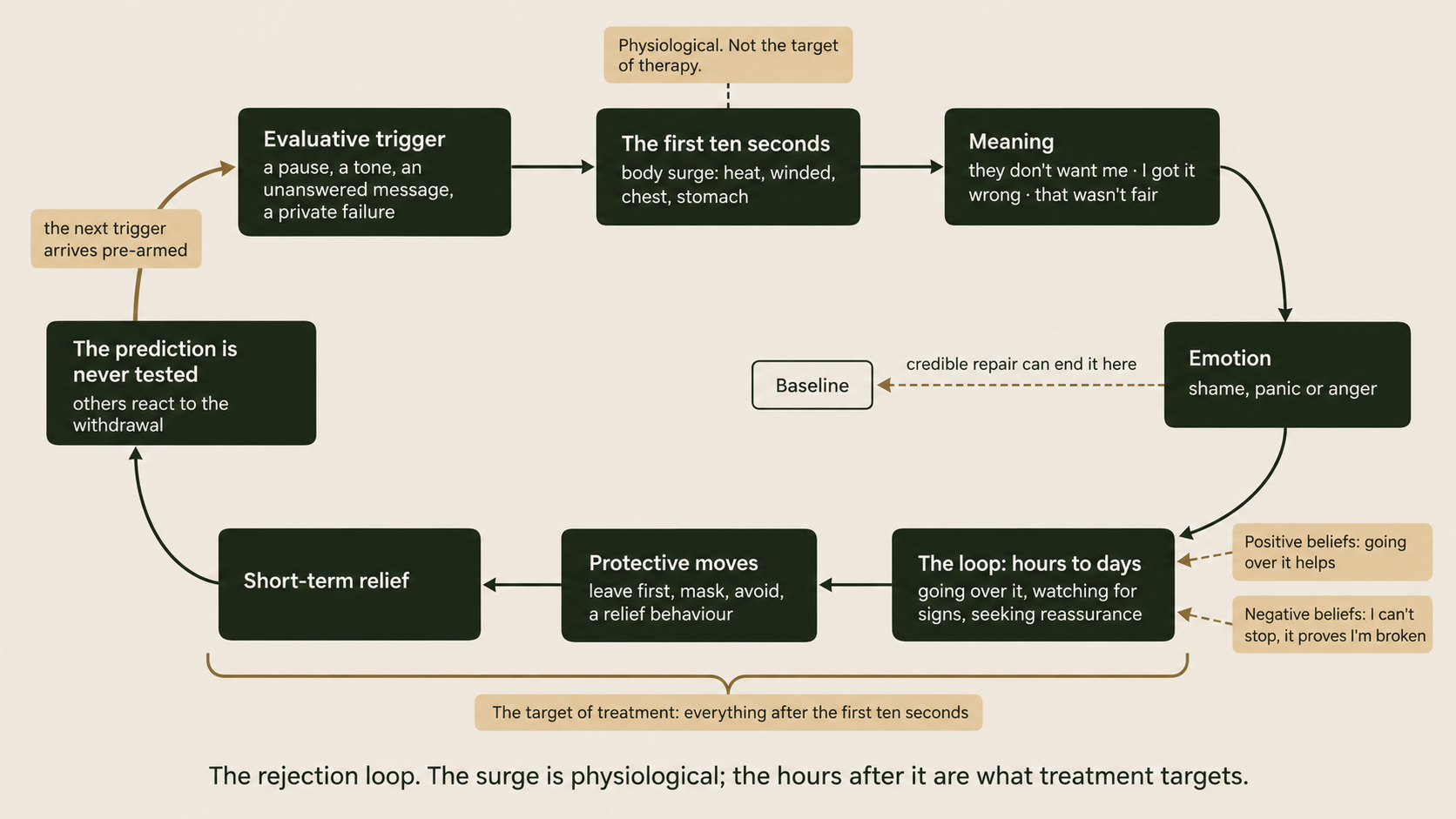
The surge in the first ten seconds is physiological. What follows is a loop of going over it, watching for signs, protective moves and short-term relief, and the prediction is never tested. Duration does not tell RSD apart from anything else: unrepaired episodes often run for days.
Withdrawal has a second cost. Each lost collaborator or friend removes support and removes the experience that would have disproved the fear. For freelancers, whose network is their safety net, that makes withdrawal a maintaining factor as well as a consequence.
Feeling intensely is part of the work. Burnout, rejection pain and mood swings are three different things.
Emotional lability in adult ADHD: g = 1.17 (Beheshti et al. 2020). In 1,235 German 10–19-year-olds, ADHD symptoms went with higher anxious and angry rejection sensitivity; in 391 adolescents, with an enhanced early neural response to peer rejection. Norwegian music and arts students: anxiety OR 1.60, depression OR 1.41 against other students. Among musicians with performance anxiety, 24–33% also meet criteria for social anxiety disorder. The load-trigger interview guide is a structured clinical aid, not a validated instrument; add the bipolar-spectrum column and the questions "Does it come with less need for sleep or a surge of ideas?" and "Does it happen even when nothing social has happened?"
One distinction runs through this whole part. Harmonious passion, where you choose the activity and can put it down, protects. Obsessive passion, where the activity is tied to your worth and you cannot stop, predicts burnout and harm, even when it looks productive. For a rejection-sensitive person, many of these behaviours are also relief: a fast way to make the pain of an episode stop.
In almost every area below, there are no studies of creatives directly. The case rests on traits that are common in creative people: ADHD, rejection sensitivity, the bipolar spectrum, perfectionism and appearance pressure.
| Area | What the evidence shows | The line to remember |
|---|---|---|
| Work | About one person in seven meets criteria for work addiction in pooled studies. ADHD, OCD and anxiety symptoms are strongly linked. Obsessive passion predicts burnout in musicians and dancers. | Separate your worth from your output. |
| Screens and social media | Total phone use is barely related to creative ability. The costs are indirect: lost boredom, fragmented attention, late light and feedback loops that act as rejection triggers. Open-ended gaming can modestly help visual creativity. | It is how you use it, not how long. |
| Spending | No evidence creatives are unusually prone, but impulsivity, emotional dysregulation, anxiety and hypomania all raise risk. Shopping after an episode is mood repair. | Add friction: a 48-hour basket rule. |
| Body image | In one clinic study, 20% of people with body dysmorphic disorder had an art or design background. Appearance-based rejection sensitivity, ADHD and filtered social media all raise the pull towards procedures. People with body dysmorphia rarely benefit from them. | For performers, Botox can blunt facial expression and emotion reading. |
| Sexual risk | People who make art seriously report more partners, a small effect driven by impulsive non-conformity rather than creativity. The clinical links run through ADHD, rejection sensitivity and hypomania. | It is impulsivity, not art, that predicts risk. |
| Adrenaline and driving | Creative people take more social risks, not more physical ones. ADHD modestly raises crash risk and medication reduces it. Adrenaline sport is often emotion regulation. | Keep the physical edge deliberate, coached and sober. |
| Over-exercise | Uncommon in general but more common in frequent exercisers and people with eating disorders. Perfectionism and body-image pressure drive it. | If you cannot take a day off, the workout is working you. |
| Gambling and trading | About one in four people harmed by gambling has ADHD. The bipolar spectrum is strongly linked. Crypto and day trading behave like gambling. Gambling disorder carries a raised suicide risk. | Your brain cannot tell a trading app from a slot machine. |
Table 4. Secondary impacts in creative lives.
Why creative settings make it easier
Six factors decide whether a relief behaviour takes hold, and they explain why. Relief is accessible: the bar, the app and the card on file are always close. It is desirable when an episode hits. Much of it is concealable. A lot of it is socially acceptable in creative culture, where long hours, drinking and a certain recklessness can read as commitment. And the external structure that protects other people, a fixed working day, a commute, a team, is often missing.
The question is never how much. It is whether you can stop.
Work addiction: 15.2% pooled across 53 studies (14.1% adjusted), 7.8% in a representative Norwegian sample (BWAS). Compulsive buying: 4.9% pooled in representative adult samples. Body dysmorphic disorder: Veale et al. (2002), 20 of 100 patients with art or design job or education; comparison with population data is mixed. Sexual partners: Nettle and Clegg (2006). Risk-taking: Tyagi et al. (2017), social domain only. Gambling: 24% of people harmed have ADHD against 2.58% population (Timms-McLean et al. 2026); Great Britain PGSI 8+ 2.4% in 2025. Use "sexual risk" or "compulsive sexual behaviour", not "promiscuity".
Where functioning shows
Almost all the evidence on life impact comes from ADHD research rather than studies of creatives. The likely picture for successful creatives is a combination: ADHD-trait strain across life, multiplied by the precarious structure of creative work, partly hidden by success and resources.
Relationships. Adults with ADHD report less satisfaction and more difficulty in relationships; those diagnosed in childhood were three times as likely to be divorced in one follow-up study. Add touring, nights and rejection sensitivity, and the strain is predictable.
Work and money. Brilliant output alongside missed invoices, unpaid tax and abandoned projects. Freelance surveys document the precarity; ADHD adds the admin gap.
Parenting. Irregular hours and an unpredictable income meet the demands of a family, often at the same age as peak career pressure.
Health. The amplifiers in Part 02 add up: short sleep, stress, substances and a hypermobile, reactive body. Famous popular musicians die earlier, mostly from lifestyle-related causes.
Risk at the gate
Risk is not a lifestyle topic. Suicide risk is raised in creative occupations, highest for women artists, and highest of all where pay is low, work is insecure and control is limited. Rejection episodes turned inward can bring thoughts of not wanting to be here. Gambling disorder and heavy substance use each add risk. Any service for creatives needs a clear way of asking about suicide and acting on the answer, with most attention on younger, freelance and performing people.
Success can hide difficulty. Track the whole life, not just the output.
Divorce: Klein (2012) longitudinal follow-up of childhood ADHD. Creative-specific impact evidence is limited to working conditions (UK freelancer and performing-arts surveys), dyslexia in art students and musician mortality. Follow NICE NG225 for suicide risk: no risk scores and no stratification; a risk formulation in every psychosocial assessment and an episode-specific safety plan.
Assessment, adapted
Sanctum's six-step assessment applies: map the variability, identify the amplifiers, evaluate the fit, confirm the developmental history, consider secondary impacts and integrate risk. For creative people, four things change. We screen for the bipolar spectrum as standard, because it is over-represented and its swings can feel productive. We ask whether reactions happen outside work evaluation. We take a frank history of the "creative fuels", including vapes, pouches, cocaine, ketamine, cannabis potency and borrowed beta-blockers. And we record the demands the work itself brings: freelance status, income stability, how much evaluation is scheduled and how much of the job is lived online.
What helps
Anchor wake time, cut late light and treat a delayed body clock. Keep idea sessions well slept.
Walking meetings and walking breaks before brainstorming. Hard training after, not before.
Use it on editing and solving days. Last cup by about 2pm.
Do not stack a pitch, a review and a launch in the same week, or in the premenstrual week.
In writing, in private and with notice. Read reviews and metrics at a chosen time, not on the phone at midnight.
A bookkeeper, body doubling, automated bills, protected time away from the work.
A 48-hour basket rule, gambling blocks, deleting trading apps, a plan made in advance for after-show nights.
ADHD, anxiety, sleep and hormonal transitions. Untreated ADHD drives much of the self-medication.
Two cautions for treatment. When antidepressants are prescribed, emotional blunting should be discussed openly, because for a creative person it can feel like losing the work. And beta-blockers for performance anxiety should be prescribed and monitored, not borrowed.
Treating the brain does not dull the work. It stops the work costing you everything else.
Screens for creative populations. ADHD: ASRS. Rejection sensitivity and regulation: A-RSQ, DERS. Mood: Mood Disorder Questionnaire. Autism where in question: CAT-Q for camouflaging. Sleep: ISI, MCTQ. Stress and burnout: DASS-42, Copenhagen Burnout Inventory; Kenny Music Performance Anxiety Inventory for performers. Substances: AUDIT-C, ASSIST-Lite, Fagerström, a seven-day caffeine diary. Eating: SCOFF, Binge Eating Scale, NIAS for autistic patients. Activity: IPAQ short form.
Clinical flags. High-potency cannabis with high schizotypy or a family history of psychosis or bipolar disorder. Psychedelics with lithium, SSRIs or a bipolar history. Heavy nicotine use as a prompt to assess for ADHD.
Seven things to keep.
ADHD traits go with stronger idea generation, peaking at moderate levels. Creative fields draw the traits; diagnosed ADHD is not shown to be over-represented.
The bipolar spectrum is the strongest population signal in creativity research, so mood swings always need a careful look.
The "creative fuels" mostly do not help ideas. Sleep and walking do. Caffeine finishes ideas rather than creating them.
Creative work is built on judgement, which makes it a purpose-built trigger for rejection sensitivity. Check whether reactions happen outside work too.
Burnout, rejection pain and mood swings look alike and need different fixes.
Passion protects when you can stop. Work, exercise, spending, sex and trading turn harmful when you cannot.
Creative careers load the top of the equation. Most of the leverage is in supports and amplifiers.
Any percentage for ADHD or RSD among members of a club. That RSD is a diagnosis. That being creative means having ADHD. That a drug, a food or a supplement makes you more creative. That gut bacteria shape creativity.
If you are having thoughts of not wanting to be here, you do not have to wait it out alone. Samaritans: 116 123. Shout: text SHOUT to 85258. NHS 111, mental health option (England). Papyrus HOPELINE247 for under-35s: 0800 068 4141. In immediate danger, call 999 or go to A&E. In the Netherlands: 113 Zelfmoordpreventie, 0800 0113 or 113.nl; in immediate danger, 112.
Built from the Sanctum Creatives Evidence Compendium and ADHD, Creativity and RSD Evidence Review (Sanctum Healthcare, October 2026), which hold the full graded evidence register. Key references: Veale et al. 2002; Nettle and Clegg 2006; Kyaga et al. 2012; Klein 2012; Tyagi et al. 2017; Beheshti et al. 2020; Hoogman et al. 2020; Dorani et al. 2021; ONS suicide by occupation 2011–15; UK Music 2022; Crime Survey for England and Wales 2025; Gambling Survey for Great Britain 2025; Timms-McLean et al. 2026. Claims in the compendium marked unverified are not used here.
These are targeted literature searches, not a systematic review, and are not a basis for diagnosing any individual. UK crisis numbers verified 11 October 2026; check the Netherlands numbers before print.