A Sanctum Education Series
The Brain in PMOS.
Polycystic ovary syndrome was just renamed. The rename is overdue. It also risks doing what the original name did: pushing the brain out of a story it sits at the centre of.
This series walks through the evidence linking PMOS to ADHD, the psychiatric labels that may be misreading ADHD in women with PMOS, the integrated framework that holds both pieces in view, and a screening tool you can use in clinic or take to one. About forty-five minutes end to end. Designed for clinicians and the women who recognise themselves in it.
The rename and what it hides
8 min read
Re-reading the diagnoses
12 min read
A Brain Health Model framing
10 min read
The Dual Screen
5 min read
Integrated practice
9 min read
Authored by Dr Asad Raffi, Consultant Psychiatrist and Founder of Sanctum Healthcare. The Brain Health ModelTM is a proprietary clinical framework of Sanctum Healthcare.
The rename and what it hides.
The new name is honest about the metabolic and endocrine reality. But it leaves the brain out of the name, just like the old one did.

From PCOS to PMOS
The Lancet published the global consensus rename this month. Polycystic ovary syndrome is now polyendocrine metabolic ovarian syndrome, or PMOS. The old name centred a cosmetic ultrasound finding while sidelining the endocrine and metabolic machinery actually driving the condition. The new name is a clinical improvement.
But by repositioning the diagnosis around the ovaries, hormones and metabolism, we may make it easier to miss the part of the picture that has been hiding in plain sight for two decades. The brain. And specifically, attention deficit hyperactivity disorder in the women who carry both conditions.
The brain still isn't named in PMOS. And the brain is where a significant portion of the suffering lives.

The link is no longer up for debate
Two independent meta-analyses now place offspring ADHD risk at around 42 per cent higher in children born to women with PCOS/PMOS than in the general population. Maleki and colleagues pooled six studies covering over 400,000 ADHD cases and found an odds ratio of 1.42 with zero heterogeneity. Dubey and colleagues analysed 19 studies covering 2.26 million children and arrived at the identical figure.
The Swedish cousin-comparison work from Cesta and colleagues is the most convincing causal evidence. Comparing PCOS-exposed offspring against both unrelated controls and unexposed cousins, the association strengthened in girls after controlling for familial confounding. That pattern is what prenatal androgen programming looks like.
Women with PMOS themselves carry the elevated ADHD signal. Hergüner and colleagues found significantly higher scores on both the Adult ADHD Self-Report Scale and the Wender-Utah Rating Scale in women with PCOS compared to age-matched controls. A 30-year longitudinal study in Neurology following over 900 women found those with PCOS scored about 11 per cent lower on attention measures at midlife.
So when we now describe PMOS, we're describing a condition that elevates ADHD risk both within the woman herself and in her daughters. Twenty years of accumulated evidence sits behind that statement.
The question that isn't being asked loudly enough
The psychiatric burden of PCOS/PMOS is now catalogued in painstaking detail. Depression at 1.65-fold elevated risk. Anxiety at 1.42. Bipolar disorder at 1.50. Psychotic disorders at 2.99. Eating disorders at three to six-fold. Suicide attempts at an 8.47-fold hazard ratio, even after adjusting for known psychiatric comorbidities. These numbers aren't wrong.
But women with ADHD also carry comparable elevations across every one of those categories. And women with ADHD are systematically underdiagnosed, missing on average by four to five years compared to men, with up to 75 per cent of girls missed entirely in childhood.
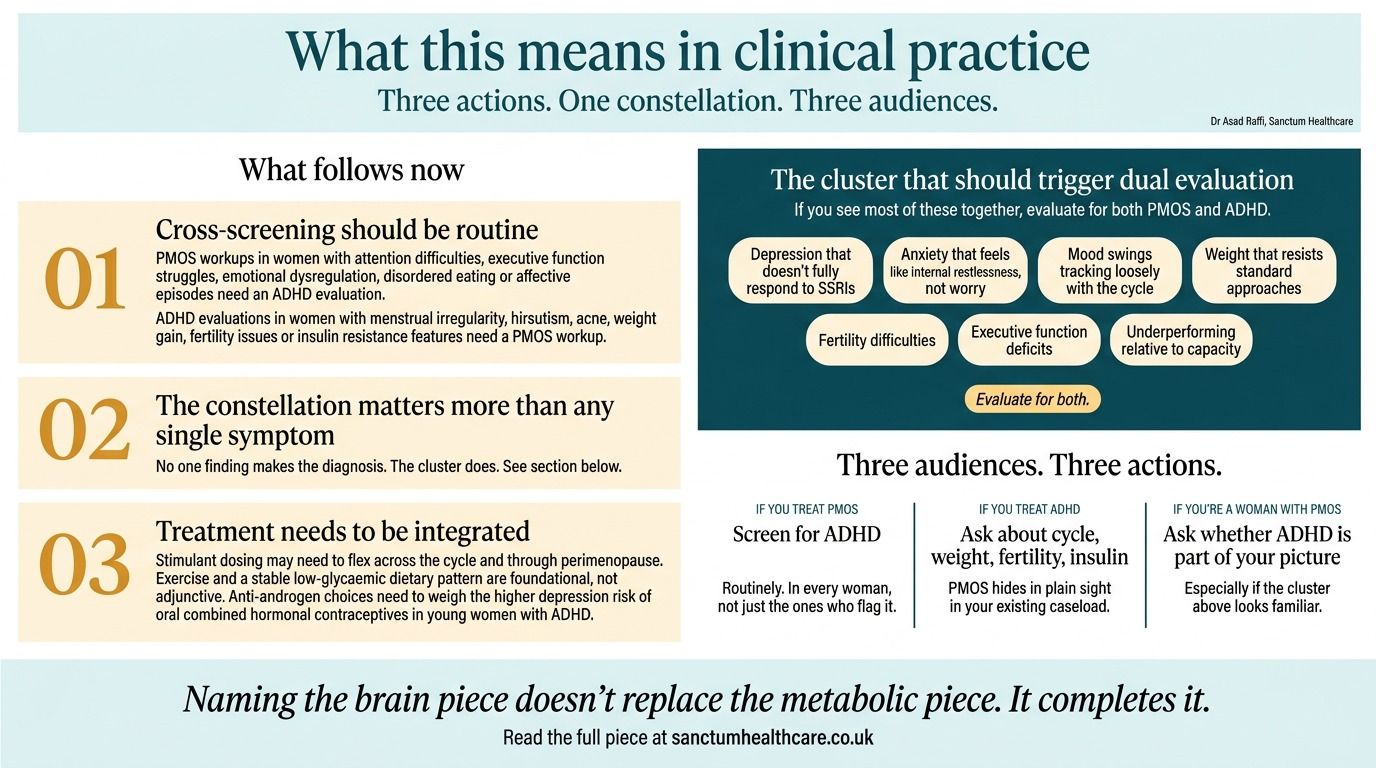
The published numbers can't tell us how much of the psychiatric comorbidity of PMOS is in fact undiagnosed ADHD wearing different clinical labels. A meaningful share of it is. The next module re-reads four of those labels.
Re-reading the diagnoses.
Four psychiatric labels routinely attached to women with PMOS that may, in significant cases, be undiagnosed ADHD presenting through a hormonal amplifier.

What makes the misattribution legitimate
The diagnostic confusion isn't careless. It's legitimate, because the underlying biology genuinely overlaps. PMOS and ADHD aren't two random conditions that happen to co-occur. They share converging mechanisms operating on the same circuits, and the surface presentations cluster accordingly.
The four reframes below are not claims that depression, anxiety, bipolar and eating disorders don't exist in PMOS. They do. The claim is narrower: that in a substantial subset of women, what's being treated as one of these labels is more accurately described as ADHD plus a hormonal amplifier, and that treating only the surface label leaves the underlying picture untouched.
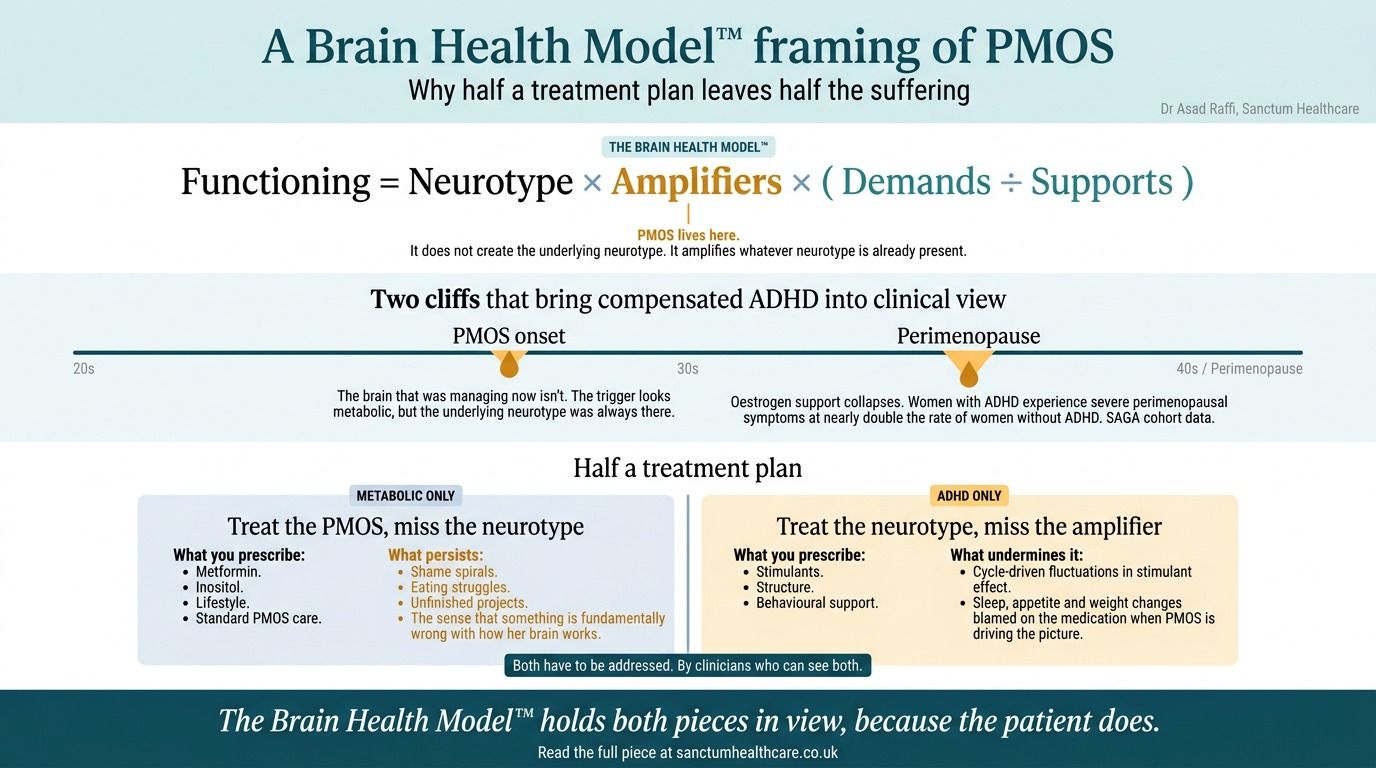
Depression, or rejection sensitive dysphoria?
Rejection sensitive dysphoria isn't yet in DSM-5, but every clinician working with adult ADHD recognises it. The sudden, disabling collapse of mood in response to perceived rejection, criticism or failure. The shame spiral. The hours or days spent unable to function after something most people would shrug off.
On the surface, RSD looks like depression. The intensity is real. The disability is real. SSRIs often partially help. But the trigger pattern is different. The mood drop is reactive, not endogenous. The recovery curve is faster. And the person typically isn't depressed between episodes in the way someone with major depressive disorder is.
What we call it
Depression
Episodic low mood. Partial SSRI response. Treated as major depressive disorder.
What it may be
Rejection Sensitive Dysphoria
Reactive mood collapses to perceived rejection or criticism. Faster recovery. Not depressed between episodes.
What distinguishes them
Trigger pattern. Inter-episode functioning. Response trajectory to interpersonal repair rather than to medication.
Anxiety, or internal restlessness?
Adult ADHD in women often presents as the inattentive type, but hyperactivity isn't absent. It moves inward. Constant mental noise, racing thoughts, an inability to switch off, low-grade somatic tension that doesn't track with any specific worry.
On a GAD-7 screening tool, that picture scores as generalised anxiety. It isn't. Add dysautonomia, which is common in both ADHD and hormonally driven conditions, and you have palpitations, lightheadedness, fluctuating heart rate and a sense of being on edge that mimics panic without being panic.
What we call it
Generalised anxiety
GAD-7 positive. Internal tension. SSRIs and benzodiazepines.
What it may be
Internal restlessness, dysautonomia
Inattentive ADHD with internalised hyperactivity. Somatic tension without specific worry content. Often resolves on stimulants.
What distinguishes them
Worry content vs. content-free tension. Response to stimulant trial. Presence of dysautonomic features.
Bipolar disorder, or RSD plus hormonal instability?
The hormonal volatility of PMOS is the perfect amplifier for emotional dysregulation. Anovulatory cycles deprive the brain of the predictable oestrogen surges that smooth out mood and cognition. Add chronic relative androgen excess and you have a hormonal background that produces state changes across days and weeks.
Layer RSD on top, with its sudden mood collapses triggered by interpersonal cues, and you have a clinical picture that looks cyclical. It pattern-matches to bipolar II. The rate at which women carry bipolar II diagnoses that don't quite fit, that don't respond well to mood stabilisers, that started in their late teens or twenties and were never reviewed against the possibility of ADHD plus a hormonal amplifier, is substantial.
What we call it
Bipolar II disorder
Cyclical mood swings. Energised dysphoria. Mood stabilisers, partial response.
What it may be
RSD plus hormonal instability
Sudden mood collapses on a backdrop of anovulatory cycles and androgen excess. Pattern-matches to bipolar but doesn't behave like it.
What distinguishes them
Trigger pattern of mood changes. Cycle correlation. Response to mood stabilisers vs. stimulants plus hormonal stabilisation.
Eating disorders, or ADHD eating?
This is the one that most clearly cuts across both conditions. Binge eating disorder is mechanistically tied to dopamine dysregulation. Lisdexamfetamine is FDA-approved for both ADHD and moderate-to-severe binge eating disorder, which tells you something about the shared neurobiology.
Insulin instability and androgen excess in PMOS amplify all of this. Glucose swings drive cravings. Body image distress from PMOS features drives restriction and rebound. The result is a clinical presentation that gets labelled comorbid eating disorder when, for many women, the same brain pathology is driving both the metabolic dysfunction and the eating behaviour.
What we call it
Eating disorder
Binge eating. Bulimia. Body image distress.
What it may be
ADHD eating amplified by PMOS
Dopamine seeking. Executive dysfunction. Interoceptive difficulty. Glucose swings and androgen excess do the rest. Lisdexamfetamine is FDA-approved for both.
What distinguishes them
Pattern of eating dysregulation. Response to ADHD treatment alone. Underlying insulin and androgen profile.

The shared biology underneath
Three converging mechanisms put PMOS and ADHD in the same neurochemistry. Prenatal androgens reshape mesocorticolimbic circuits in a sex-specific way: girls with CAH show 71 per cent higher ADHD prevalence than unexposed girls, with no signal in boys. Oestradiol upregulates dopamine synthesis and slows clearance: anovulatory cycles in PMOS strip that signal across the reproductive lifespan. Insulin signalling via PI3K/Akt is required for normal dopamine transporter function: insulin resistance disrupts it, and reduced insulin sensitivity correlates with lower endogenous dopamine at striatal D2/D3 receptors on PET.
A Brain Health Model framing.
A clinical framework for holding the metabolic and neurodevelopmental pieces in view at the same time. PMOS as amplifier, two life-stage cliffs, and the half-treatment problem.

The framework
In clinical practice I use an equation that helps me hold both pieces in view at once. It treats functioning as a product of who the brain is, what's amplifying its underlying patterns, and the balance between what the person is being asked to do and the resources they have to do it.
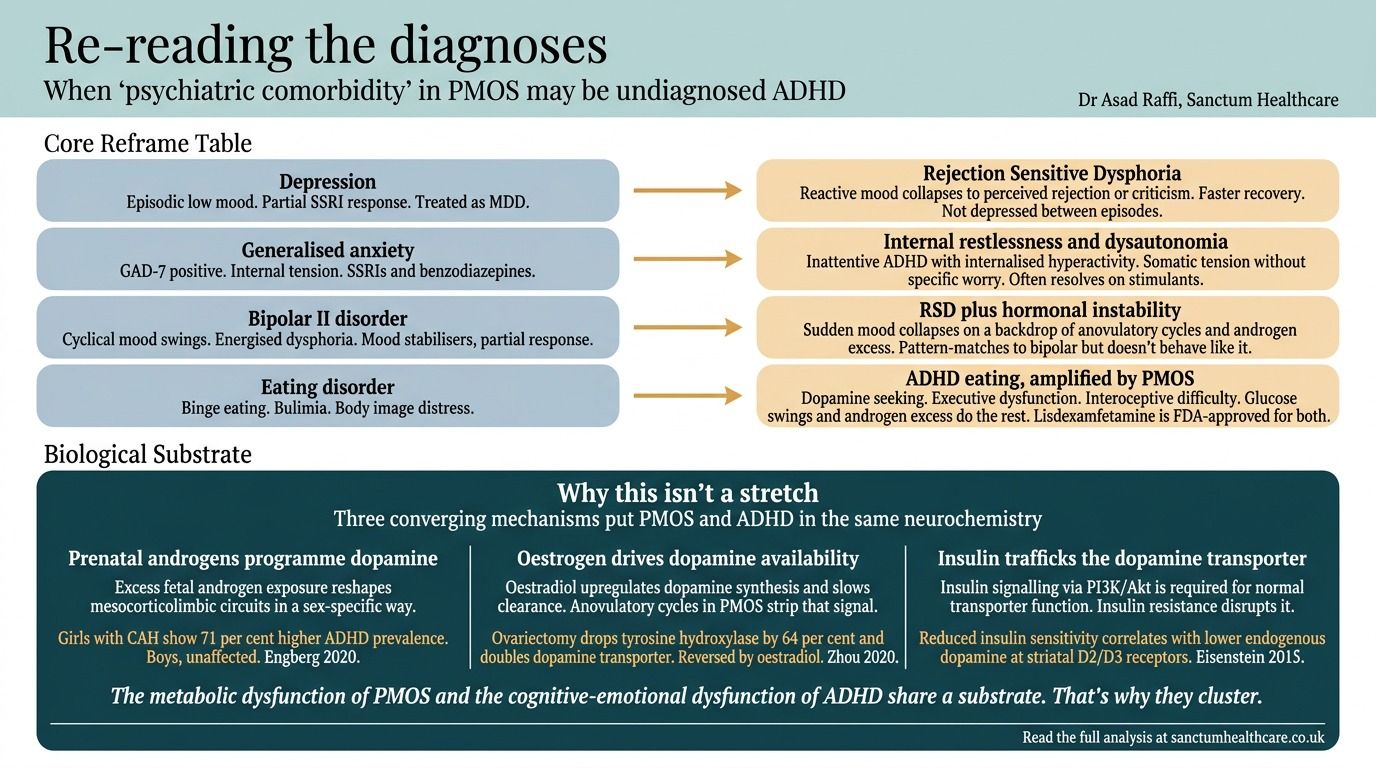
PMOS sits squarely in the amplifier category. It does not create the underlying neurotype. It amplifies whatever neurotype is already present. For a woman with quiet, compensated ADHD through her twenties, the onset or worsening of PMOS in her late twenties and thirties may be what tips the system into clinical visibility. The brain that was managing now isn't, and the trigger looks metabolic and hormonal because that's the surface change, but the underlying neurotype was always there.
Two cliffs
There are two predictable inflection points across the reproductive lifespan where compensated ADHD becomes clinically visible. The first is PMOS onset, often in the late twenties to mid-thirties. The second is perimenopause, when oestrogen support collapses and both conditions worsen together.

Half a treatment plan
The framework predicts the failure mode. Treating only the metabolic piece leaves the underlying neurotype unaddressed. The woman improves metabolically and still can't get a day's work done. She still has the shame spirals, the eating struggles, the unfinished projects, the sense that something fundamental is wrong with how her brain works. Those don't lift with metformin alone.
Treating only the ADHD piece ignores the metabolic and hormonal amplifier sitting underneath. The stimulants help, but they help less than they should. Effectiveness fluctuates across the cycle. Sleep, appetite and weight all interact in ways that get blamed on the medication when the underlying PMOS is driving the picture.
Both have to be addressed. By clinicians who can see both.
What this means in practice
The Brain Health Model isn't an instruction to do more. It's an instruction to keep both axes on the table at the same time. A consultation that asks about cycle, weight and insulin alongside attention and emotional regulation. A treatment plan that adjusts stimulant timing across the cycle if needed. A lifestyle prescription that hits both metabolic and cognitive targets simultaneously. A medication review that weighs anti-androgen options against the higher depression risk from oral combined hormonal contraceptives in young women with ADHD.
The work isn't simple. But it's only possible if both conditions are on the table.
The Dual Screen.
A structured screening tool that captures ADHD features (including female-presentation items), PMOS clinical features, and the convergent constellation that distinguishes a dual picture from either condition alone.
Twenty-five items across three short sections. ADHD features on a five-point frequency scale, PMOS features as yes or no, and the seven-item convergent constellation. The output is a stratified recommendation, not a diagnosis.
Complete it yourself if you're investigating your own picture. Use it as an interview prompt if you're a clinician. Either way, the result is a starting point for clinical review, not the end of one.
Part one: attention and executive function
For each statement, indicate how often it has applied to you over the past six months.
I find it hard to wrap up the final details of a task once the difficult part is done.
I have trouble getting things in order when a task requires organisation.
I have problems remembering appointments or obligations.
I avoid or delay starting tasks that need a lot of thought.
I fidget, squirm, or feel physically restless when I have to sit for long periods.
I feel mentally restless or compelled to be busy, as if driven by a motor.
My mind races, or I struggle to switch off when I want to rest.
Perceived criticism, rejection, or failure affects me more intensely than seems proportionate.
I have a persistent sense that I'm underperforming relative to what I'm capable of.
As a child, I was described as a daydreamer, scattered, or 'in my own world.'
Part two: endocrine and metabolic features
Yes or no, based on current or historical experience.
My periods are irregular (cycles longer than 35 days, or fewer than eight cycles per year).
I have excess hair growth on my face, chest, or abdomen.
I have persistent acne that continued or developed beyond adolescence.
I have noticeable thinning of hair on my scalp, particularly at the temples or crown.
I carry weight around my middle and find it resistant to usual approaches.
I have had difficulty conceiving, or know I am likely to.
I have a family history of PCOS or PMOS, type 2 diabetes, or gestational diabetes.
I notice strong sugar or carbohydrate cravings, or energy crashes after meals.
Part three: the convergent cluster
The constellation matters more than any single symptom.
Depression that has not fully responded to SSRI treatment.
Anxiety that feels more like internal restlessness than worry about specific things.
Mood changes that loosely track with the menstrual cycle.
Weight that resists dietary or exercise approaches.
Fertility difficulties or significant menstrual irregularity.
Executive function difficulties (planning, follow-through, time management, prioritisation).
A persistent sense of underperforming relative to capacity.
Scores
Recommended actions
Integrated practice.
Three clinical actions, one constellation, three audiences. What this means in the room with the patient, and what it asks of two specialties that don't yet talk to each other.

Three actions
The argument across the first four modules narrows to three operational changes in how PMOS and ADHD are screened, evaluated, and treated. None of them are radical. None of them are yet routine.
01. Cross-screening should be routine
Any woman presenting for PMOS workup with a history of attention difficulties, executive function struggles, emotional dysregulation, disordered eating or affective episodes deserves an ADHD evaluation. Any woman presenting for ADHD evaluation with menstrual irregularity, hirsutism, acne, weight gain, fertility issues or features suggesting insulin resistance deserves a PMOS workup. Neither field currently mandates this, and neither field will until clinicians demand it.
02. The constellation matters more than any single symptom
No single finding makes either diagnosis. The cluster does. Depression that doesn't fully respond to SSRIs, anxiety that feels like internal restlessness more than worry, mood swings tracking loosely with the cycle, weight that resists standard approaches, fertility difficulties, executive function deficits, a persistent sense of underperforming relative to capacity. That cluster should trigger evaluation for both conditions, not one or the other.
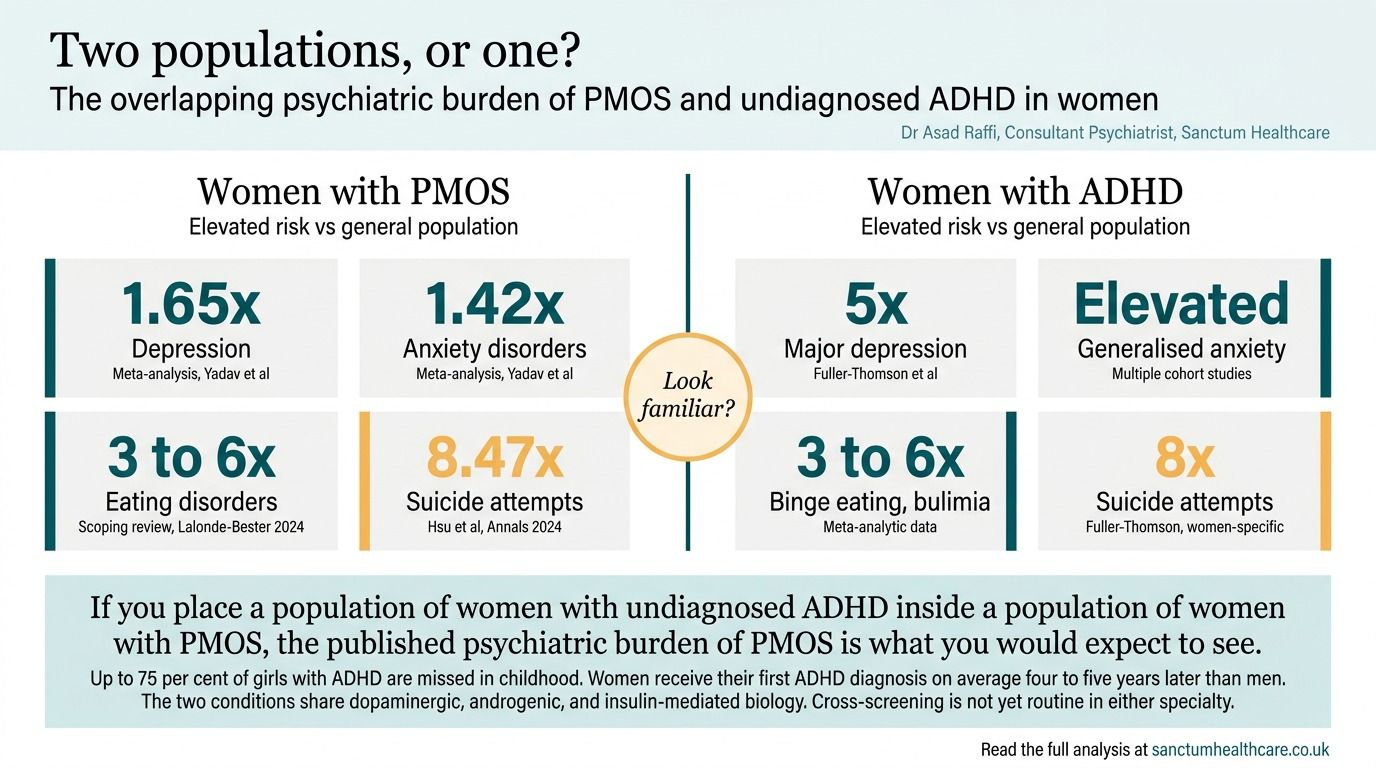
03. Treatment needs to be integrated
Stimulant dosing may need to be flexible across the menstrual cycle and through perimenopause, as De Jong's pilot work suggested. Lifestyle interventions, particularly structured exercise and a stable low-glycaemic dietary pattern, hit both targets simultaneously and should be foundational rather than adjunctive. Anti-androgen options need to be weighed against the higher depression risk from oral combined hormonal contraceptives in young women with ADHD that Lundin documented. The conversation isn't simple, but it can only happen if both conditions are on the table.
The brain belongs in this conversation
The rename from PCOS to PMOS is a clinical improvement. Polycystic ovary syndrome was always too narrow. Polyendocrine metabolic ovarian syndrome captures more of the biology, more of the systemic reach, more of the longitudinal trajectory.
But the brain still isn't named, and the brain is where a significant portion of the suffering lives. The cognitive symptoms, the emotional dysregulation, the eating struggles, the executive function deficits. These aren't ornaments on a metabolic condition. For many women, they are the centre of the experience, and they share their biology with a neurodevelopmental condition that's already chronically underdiagnosed.
Naming the brain piece doesn't replace the metabolic piece. It completes it.

Series complete
Both have to be addressed.
By clinicians who can see both.
The Brain Health ModelTM holds the metabolic and neurodevelopmental pieces in view simultaneously, because the patient does.
If this series has flagged a dual picture in someone you care for, or in yourself, the next step is integrated assessment. Sanctum Healthcare provides specialist neurodevelopmental and hormonal-cognitive evaluation across the female reproductive lifespan.
Female ADHD and autism assessmentsThe Brain in PMOS © Sanctum Healthcare. Authored by Dr Asad Raffi, Consultant Psychiatrist. The Brain Health ModelTM is a proprietary clinical framework. This series is educational and does not replace clinical assessment.